Rated · TOURS
Must See Running Tour Of Sevilla
Seville is a city made for walking, but a running tour turns that idea up a notch. You cover major landmarks in a short time, then you still get the street-level feel that makes Seville memorable, especially early in the day.
I like two things a lot. First, the route is planned to avoid over-crowded areas, so your photos and your breathing space feel better. Second, the guide, Mike, keeps things flexible, matching your pace and attitude, with easy conversation plus practical tips like where to eat.
One consideration: this is outside-only sightseeing. You see big sights up close from the street, but you will not enter buildings, even when the route passes places with paid tickets inside.
Key highlights you will feel in the first 15 minutes
- Early-morning streets that are calmer before the day heats up and crowds build
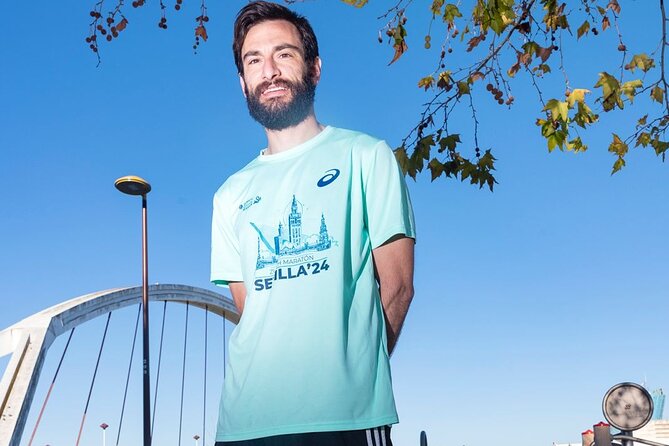
- Guide Mike’s pace matching, including encouragement for slower runners and faster strides for training days
- Seamless navigation that keeps you moving without constantly stopping to find your bearings
- UNESCO icons from the outside, including the Alcázar and the Cathedral complex
- A route that mixes photo stops with real local corners, like Alameda de Hercules and Santa Cruz lanes
- English-language running tour with a mobile ticket and private-group format
Why a 2-hour run feels like the best introduction to Seville
A good Seville plan is all about timing. This tour runs during the early windows on Monday or Tuesday, with morning hours starting at 7:00 AM and an evening option later. Going early matters because you get the city’s atmosphere before the sidewalks fill.
You also get an efficient line through the city without a bus. That is the real value of a running tour: it turns geography into motion, so the places start to connect in your head, not just sit as isolated “things to see.”
The group stays outside the whole time, which means you are not stuck waiting at entrances. Instead, you can focus on what you can actually enjoy on foot: street scale, architecture details at eye level, and the way neighborhoods change block by block.
More of Seville worth an open tab:
- Seville: Live Flamenco Dancing Show Ticket at the Theater
★ 4.7 · 16,396 reviews - Seville: 1-Hour Guadalquivir River Sightseeing Eco Cruise
★ 4.2 · 10,281 reviews - Seville: Cathedral, Giralda, and Royal Alcázar Guided Tour
★ 4.7 · 9,165 reviews
Price, private setup, and what $53.61 buys you
At $53.61 per person for about 2 hours, you are paying for three things: a guide, a planned running route, and time savings. In Seville, time is currency, and “see a lot” is only useful if it is done without chaos.
This is offered in English and set up as a private tour/activity, meaning only your group participates. That matters for comfort and pacing. If your pace is slower, you do not get dragged along with strangers who want a different tempo.
You also get a mobile ticket, plus group discounts. There is not a long list of add-ons to think about, since the tour stays outside and does not include admission to buildings.
Outside-only sightseeing: what you get, and what you do not
This tour is intentionally built around viewing. Even when the route passes places that are famous for interior beauty, the experience stays at street level.
That can be a deal-breaker if you want to tour the inside of major monuments. But if you mainly want architecture context, photo angles, and orientation for later self-guided visits, this format is strong. You walk away with a map in your mind, plus names you can search later when you are ready to buy timed entry tickets.
The other nice part is that you are not losing time to lines. Your route includes quick stops for photos and explanations, with some time also allotted for transport between areas so the pacing stays realistic.
Running pace and the moderate fitness level in real life
The tour is listed for moderate physical fitness. Translation: you should feel comfortable running or jogging for stretches, plus handling repeated stop-and-start moments at viewpoints.
If you are training, this is the kind of run that can help you keep consistent rhythm. One runner who was training for the London Marathon described it as a useful way to keep up training while seeing the city. The key is that Mike can adapt, including pushing a bit when you have it, or slowing down if you need it.
If you are newer to running, you still can make this work. The route concept is about moving efficiently across town while staying friendly about pace, so you are not stuck feeling behind the group.
Still around Seville, a different sort of day:
- Seville: Setas de Sevilla Entry Ticket
★ 4.6 · 8,901 reviews - Seville: Cathedral, Giralda & Alcazar Entry With Guided Tour
★ 4.6 · 8,560 reviews - Seville: Priority Access Cathedral, Giralda & Alcázar Tour
★ 4.8 · 7,563 reviews - Seville: Guadalquivir River Cruise
★ 3.9 · 6,921 reviews
Alameda de Hercules to Plaza Nueva, where the morning feels local
You start at Alameda de Hercules, one of Seville’s oldest public spaces. It is a classic “morning starts here” kind of place, with trendy cafes and bars nearby and a steady flow of people who seem like they belong there. The guide typically uses this first stop to set the tone and help you understand where you are in the city.
From there you head to Plaza Nueva, a key square tied to Seville’s marketplace history. You can also look for water fountains here. The fountain detail sounds small, but on a morning run it is a reminder to slow down for a drink break if you need it.
This opening segment is a practical warm-up. You get a quick sense of the streets’ width, the pavement feel, and how your pace fits the route before you reach the big-ticket photo zones.
Cathedral complex views: orange trees, Plaza del Cabildo, and Archivo de Indias
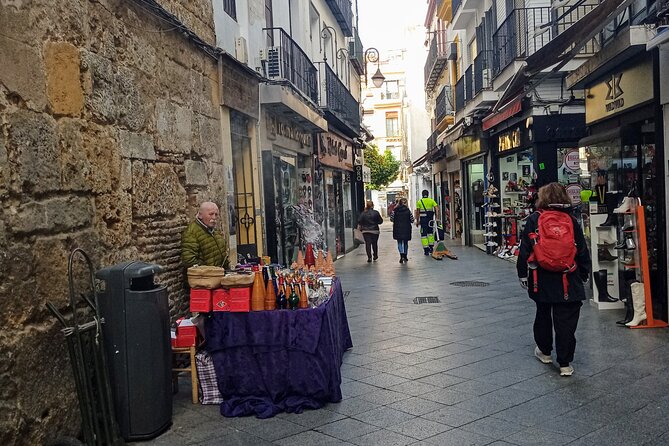
Next comes the Cathedral area, and even without entering, you get a concentrated hit of “this is important” energy.
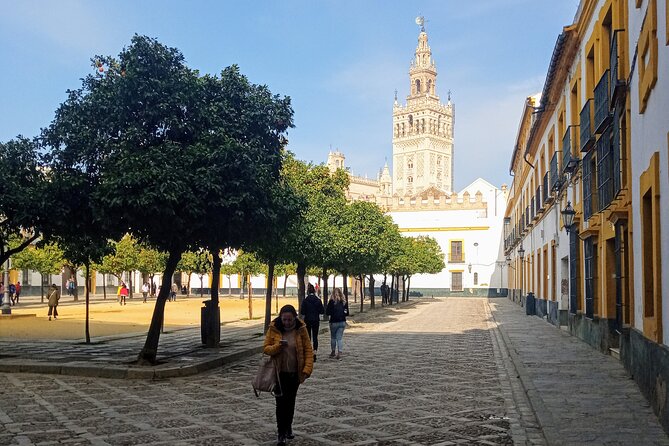
At the Orange Tree Courtyard, the famous rows of orange trees are your visual hook. From outside, you are looking for the sense of calm and symmetry that makes the courtyard feel like a pause button in the middle of historic Seville.
Then you reach Plaza del Cabildo, a photogenic square right by the Cathedral grounds. It is a good moment to stop and just look at the mix of stonework and open space, because it helps you understand how these monumental buildings sit inside the older street grid.
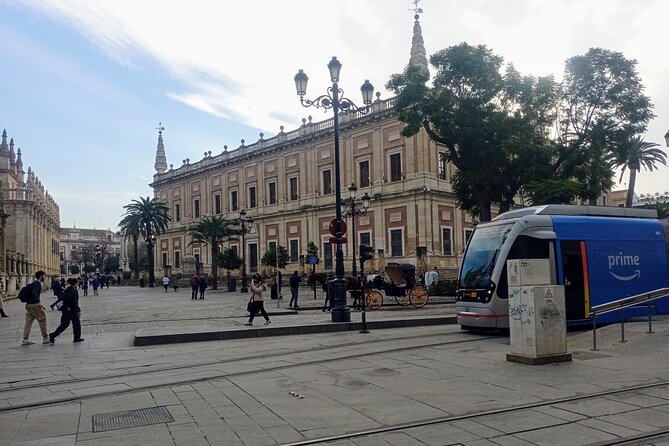
Finally, you pass Archivo General de Indias, a UNESCO World Heritage site housed in a majestic Renaissance building next to the Cathedral. Even from the outside, the point lands: this is where the story of Spain’s exploration and colonization of the Americas is preserved through documents. Your guide can help you connect that global history to the local architecture and civic power you see in Seville.
Because this section is so dense with major sites, it is also a spot where the early timing helps. In the morning, you can usually take photos without fighting for space.
Maestranza, Torre del Oro, and San Telmo: power by the river
From the Cathedral zone, the route moves toward Seville’s riverfront mood.
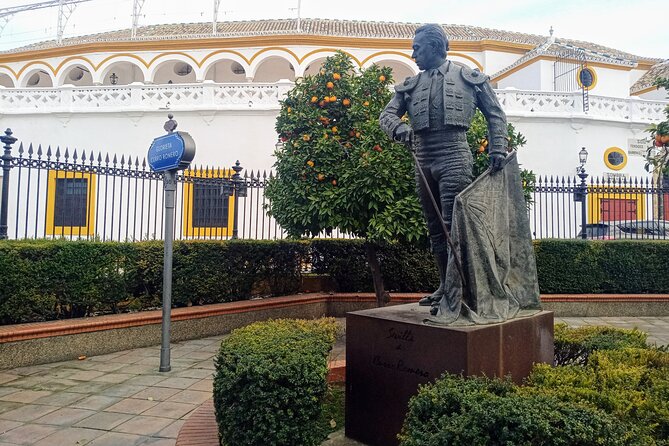
You stop near Plaza de Toros de la Real Maestranza de Caballeria de Sevilla, one of Spain’s oldest and prestigious bullrings, with its inauguration dating back to 1761. If you are not looking to attend an event, you still get the cultural context from the building’s presence, and there is a water fountain nearby for a quick reset.
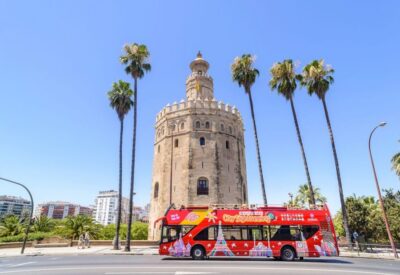
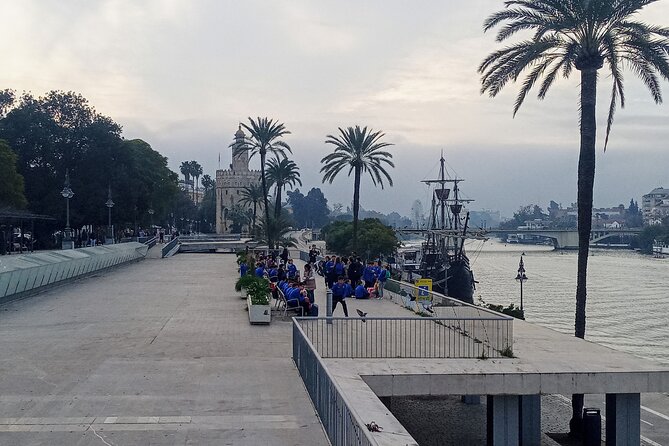
Then you see Torre del Oro, a vestige of Seville’s Moorish past built in the early 13th century during the Almohad dynasty. The name matters, and the tower’s location helps you picture how Seville defended and controlled movement along the water.
Next is Palacio de San Telmo along the Guadalquivir River. You get an immediate read on Andalusian Baroque architecture from the street, which is a great way to spot style differences without needing to tour inside.
This river-adjacent section is where the run starts to feel more like a city stroll with purpose. You are moving, but you can also take in the way Seville opens up toward the water.
Maria Luisa park loop and Plaza de España: big visuals, comfortable pacing
Then you shift into greenery with Parque de Maria Luisa. The tour takes one loop around the park, which is perfect on a run because you get more open paths and less stop-and-search time. This is also the kind of place where you can steady your breathing and reset your legs.
After the park, you reach Plaza de España, the most famous and visited plaza in Seville. Even if you have seen pictures, seeing it in person is different because the craftsmanship and scale are hard to compress into a screen. This stop works as a high-impact photo moment without requiring tickets.
One practical tip: treat Plaza de España as both a view and a pause. If you want to buy or eat something later, this area is where you’ll remember it was right here, and it becomes easier to plan your afternoon flow.
Real Fabrica de Tabacos and Jardines de Murillo, a quieter pocket mid-run
Next comes a change in tempo.
You pass Real Fábrica de Tabacos, which used to be a royal tobacco factory and now houses the main building for the University of Sevilla. From outside, the key is recognizing the building type: big civic structure energy, built to last, now repurposed. It is a good stop for architecture lovers, and it also gives you a sense of how Seville’s past industries became modern institutions.
Then you reach Jardines de Murillo, which offer tranquility compared with the older street grid. Even for runners, these kinds of garden breaks help prevent the tour from feeling like nonstop sightseeing. It is a gentle mental reset.
Santa Cruz lanes and Calle Marmoles: history at ankle height
You enter Barrio Santa Cruz, the old Jewish quarter, known for narrow cobblestone streets, whitewashed buildings, and little plazas that feel tucked away. On a run, this neighborhood is all about foot feel and turns. You will notice how quickly the character changes when streets tighten and people move more slowly.
Then you pass Calle Marmoles, where you can see the site of old Roman columns. You might not get the same “wow” as a full monument visit, but the idea is powerful: you are literally walking where layers of Seville overlap. Your guide can point out what you are looking at so it does not just feel like random street detail.
Next comes Plaza del Salvador, a focal point for social life and cultural events. Even without lingering, the square gives you a sense of where the city’s daily rhythm shows up.
This area is the one that makes the running tour feel less like a checklist and more like an orientation walk. It helps you picture where you will want to return later, when you have more time to slow down.
Alcázar and Catedral exteriors, plus Setas de Sevilla and Palacio de las Dueñas
The route then circles back into the “icons” zone, still outside-only.
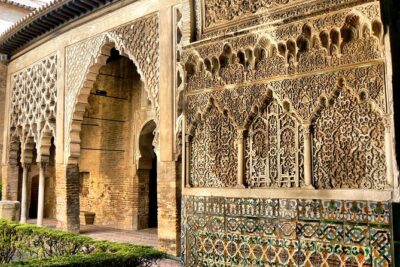
You see Real Alcázar de Sevilla, a UNESCO World Heritage site with a royal palace complex that blends Moorish, Gothic, Renaissance, and Baroque styles. You will not go inside, but the outside context is still worth it. It helps you understand why people plan big parts of their trip around this area.
Then you see Catedral de Sevilla, also UNESCO, the third largest cathedral in the world and the largest Gothic cathedral in the world. Again, you view it from the street. That said, seeing the Cathedral complex from outside is still awe-producing because the building scale is so overwhelming even without stepping in.
You may also notice Calle Marmoles and the Santa Cruz architecture again in your mental map, since this section reinforces the layers of the city core.
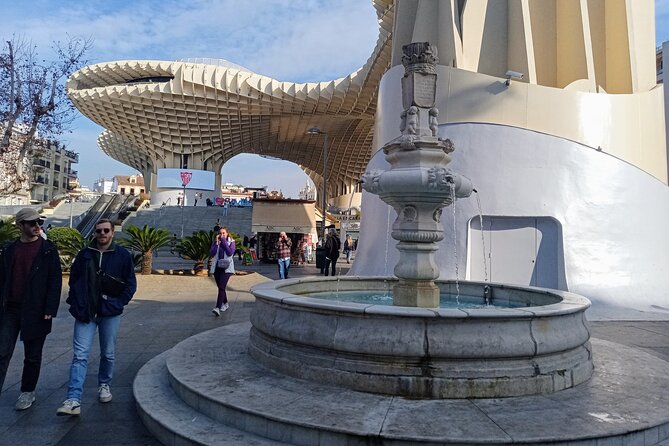
Next up is Setas de Sevilla (Metropol Parasol), affectionately known as Las Setas. This is modern architecture that makes the skyline look different overnight. From street level, the contrast is the point, because it shows how Seville keeps moving forward while staying rooted.
After that, the route passes Palacio de las Dueñas, associated with the Duchess of Alba. It is not your typical tourist shortcut, so it can feel more like a purposeful curiosity stop. From outside, you get the “someone important lived here” vibe without a ticket line.
This cluster of stops is where Mike’s approach really matters. The guide can explain what you are seeing in a way that makes the architecture feel connected, not random.
Arco de la Macarena to Torre Perdigones: finishing with viewpoints
Near the end, you hit two more historic markers that also work as a natural wrap-up.
The route includes the Arco de la Macarena, a symbol of religious devotion and Seville’s defensive walls. An arch like this tells you a lot about how the city moved, protected itself, and organized public space.
Then you reach Torre Perdigones, which offers panoramic views of the city and the Guadalquivir River. This is the kind of stop that helps you mentally “zoom out.” After an intense run through tight streets and major monuments, you get that wide-angle perspective, and it makes future navigation easier.
Practical tips so your run feels smooth, not stressful
Even a well-planned running tour can feel rough if you show up unprepared.
Bring comfortable running shoes with a grip that works on cobblestones. You do not want to think about your footing while your guide is talking through the city’s landmarks.
Plan your water strategy. The tour includes stops with water fountains at certain points, like Plaza Nueva and near the bullring. Still, you will likely want your own water bottle too, because you cannot rely on every stop to be a refill.
Finally, let the guide know early what pace you want. Mike seems to run with you, not ahead of you, and that is the difference between a fun morning and a forced march.
Who should book this running tour, and who should skip it
This is a great fit if you want an active way to see Seville’s big landmarks while also getting local street flavor. It works well for people who like structure but also want flexibility in pacing.
It is also smart for repeat visitors who want a new angle. One runner who had been coming to Seville for years still found new sight connections through the route and stop explanations.
Skip it if you want to spend most of your time inside major monuments. Since the tour stays outside, you would need separate timed tickets for places like the Alcázar and the Cathedral if interior viewing is your priority.
Should you book this Must See Running Tour Of Sevilla?
If your goal is orientation plus iconic photos, this tour is a strong choice. The combination of English guidance, outside-only access, and an early start makes it a practical way to reduce planning stress.
You should book if you like running, or if you can jog comfortably for a moderate session and want your guide to tailor the pace. Mike’s track record of adjusting to different runners, while keeping the run moving and the city context clear, is exactly what makes this experience feel worth the money.
You might skip it if the inside of monuments is the main reason you are coming to Seville. This is not an entry-ticket tour. It is a street-level, motion-based introduction, and that is the trade.
FAQ
What is the duration of the Must See Running Tour Of Sevilla?
The tour lasts about 2 hours.
How much does the tour cost per person?
The price is $53.61 per person.
What is included, and what is not included?
It includes a running tour. It does not include admission to buildings, and the experience stays outside only, even when passing major sights.
Does the tour enter monuments like the Alcázar or the Cathedral?
No. The tour only stays outside and does not enter any buildings.
What language is the tour offered in?
The tour is offered in English.
Where does the tour start and where does it end?
This activity ends back at the meeting point.
What days and times does the tour operate?
The listed opening hours are for Monday to Tuesday, 7:00 AM to 9:00 AM and 6:30 PM to 7:30 PM, for the date range shown.
Is the tour suitable for everyone in terms of fitness?
It recommends a moderate physical fitness level. Service animals are allowed, and it is near public transportation.
Recently reviewed around Seville
- The Villages of Andalusia: Full-Day Trip from Seville★ 4.8 · 19 reviews
- From Seville: White Villages Tour★ 5.0 · 9 reviews
- White Villages and Ronda: Day Trip from Seville★ 4.9 · 89 reviews
- White Villages & Ronda 2-Days Trip & Overnight Stay★ 4.6 · 5 reviews
- Seville: Guided visit of the Casa de Pilatos with entrance tickets★ 4.3 · 18 reviews
- Triana Market Tapas Tour★ 4.9 · 12 reviews
- Your Photo Story in Seville★ 5.0 · 16 reviews
- Transfer Hotel Seville-Seville Airport★ 4.5 · 15 reviews
Tours, side by side.
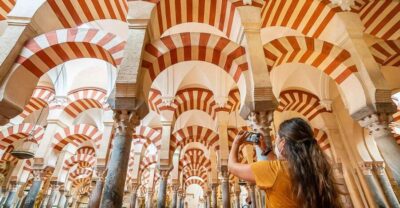
Skip-the-Ticket-Line Mosque-Cathedral Guided Tour
Read our review →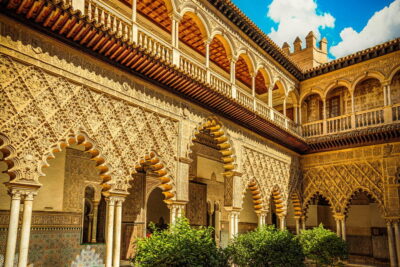
Cathedral, Giralda, and Royal Alcázar Guided Tour
Read our review →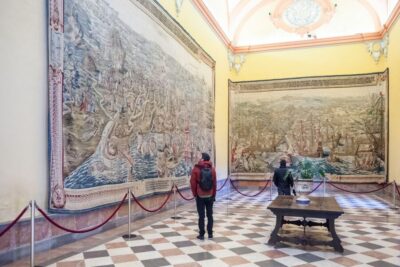
Cathedral, Giralda & Alcazar Entry With Guided Tour
Read our review →Priority Access Cathedral, Giralda & Alcázar Tour
Read our review →
Cordoba Mosque-Cathedral: Skip-the-Line Guided Tour
Read our review →
Alcázar and Cathedral Entry Ticket and Guided Tour
Read our review →