
Rated · SEVILLE
The Seville of the 3 Cultures
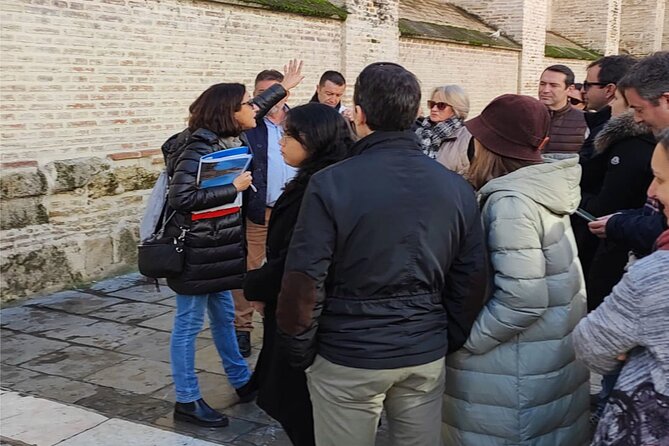
Seville of the 3 Cultures is interesting because it turns a normal stroll into a timeline you can feel, from ancient Medinaside streets to the riverfront world of Triana. You follow the city’s turning points through squares, church-adjacent courtyards, and old Jewish Quarter lanes, with stories tied to what you can actually see. The route feels made for getting your bearings fast, especially if it’s your first time in Seville.
I like the story-first guide approach, where each stop comes with a character, a legend, or a detail that explains why the place matters. I also like the strong photo logic, especially around Giralda views and the final Torre del Oro moment, so you are not just walking, you are aiming your camera. If your guide is Alfredo or Jose, you can expect lively neighborhood context and confident storytelling.
One possible drawback: it’s packed. Each place gets only a short window, and a few sights are marked as admission not included, like the Palacio Arzobispal, Puerta del Leon, the Archivo General de Indias, and Torre del Oro. So you’ll enjoy the exteriors and the narrative focus, but you may want extra time if you want to fully enter every building.
Key highlights to expect
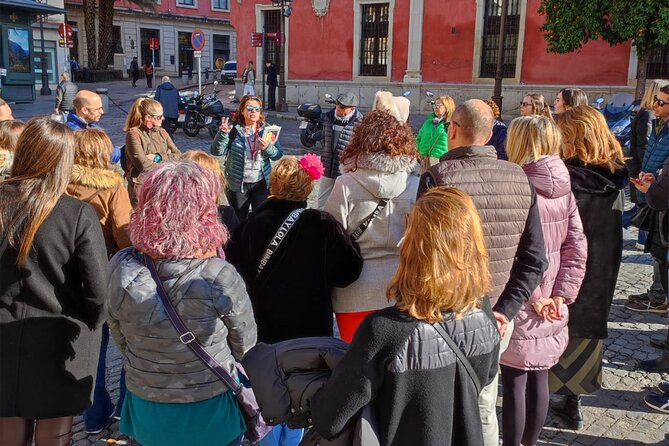
- A 2-hour, max-20 group walk that keeps the pace lively without feeling like a parade
- Giralda-adjacent viewpoints plus a focus on where to stand for the best pictures
- Santa Cruz and the Jewish Quarter lanes with legends and superstition-style curiosities
- Royal Alcazars area connections tied to the royal gates and wall lines you can still trace
- River finale at Torre del Oro with a satisfying end-of-route payoff
Mapping Seville’s three-culture crossroads in two hours
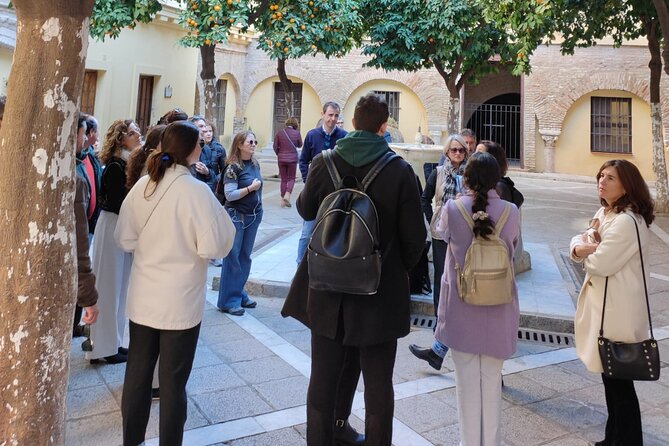
This tour is built around the idea that Seville did not become itself all at once. You move through the city in a way that keeps asking: who controlled this place, what changed, and what still shows up in the stones? That’s why it works so well on a first visit. You don’t need a long lecture, you just need the right sequence of streets.
You start in the Casco Antiguo area and head toward the Plaza level that helps the city make sense. Then you peel into the older lanes near the medieval heart, where the names and shapes of squares feel like clues. The guide’s framing connects Roman Seville as an administrative and commercial center, then the Al-Andalus period, then the Almohad era of maximum splendor, and finally the Christian shift after Ferdinand III. You do not have to memorize dates, because the places you pass do the teaching.
It’s also a good reminder that coexistence was not a tidy museum label. The tour’s tone is about transformation, overlap, and friction, with the Jewish community leaving a visible mark in the city. That theme follows you from squares like Santa Marta and Alianza into quieter streets where the storytelling gets more personal.
More of Seville worth an open tab:
- Seville: Live Flamenco Dancing Show Ticket at the Theater
★ 4.7 · 16,396 reviews - Seville: 1-Hour Guadalquivir River Sightseeing Eco Cruise
★ 4.2 · 10,281 reviews - Seville: Cathedral, Giralda, and Royal Alcázar Guided Tour
★ 4.7 · 9,165 reviews
What $13.88 buys you, and why the max-20 group helps
At $13.88 per person for about 2 hours, you’re paying for something very specific: guided orientation plus narrative. This is not a “get a brochure and wander” deal. It’s a compact way to cover key landmarks and neighborhoods without spending half your day searching for what to see next.
The small group size matters. With a maximum of 20 people, your guide can keep the flow of the walk, stop for context, and still move at a human pace. Service animals are allowed, and the route is listed as near public transportation, so it’s generally practical if you need to pop in and out of the walking rhythm.
One more value point: the tour uses a mobile ticket, which cuts down on friction. You spend less time coordinating paperwork, and more time just starting the walk. And with an average booking window of 27 days in advance, it’s clearly popular enough that planning ahead is smart, especially in busy weeks.
From Plaza de San Francisco to Ayuntamiento: city divisions and first legends
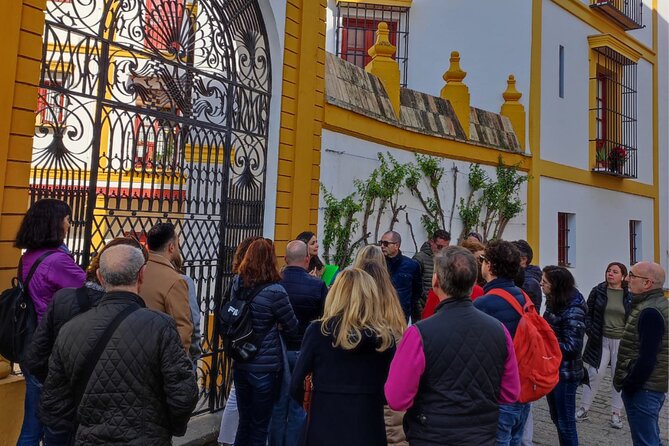
The meeting point is Pl. de S. Francisco, 17, in the Casco Antiguo, and you start with momentum right away. After a short introduction, the first major stop is at the Ayuntamiento de Sevilla area. This square is described as dividing Seville between the old commercial zone and the more monumental side, with Calle Sierpes referenced as a key artery. It’s a useful first mental map: commercial energy here, grand power there.
From that opening, you’re set up to notice how Seville’s layout can feel like two stories stitched together. That matters later when you pass through the cathedral-adjacent spaces and then swing toward the older Jewish Quarter streets. If your brain needs structure, this first segment gives it structure fast.
You’re also learning how the guide talks about places: not as isolated “things to see,” but as points in a chain of control. That’s why the Ayuntamiento stop is not just a pretty square in the beginning. It’s a way to understand how the city organized itself, then re-organized itself.
Giralda area power and perspective at Puerta del Perdon and Plaza de la Virgen de los Reyes
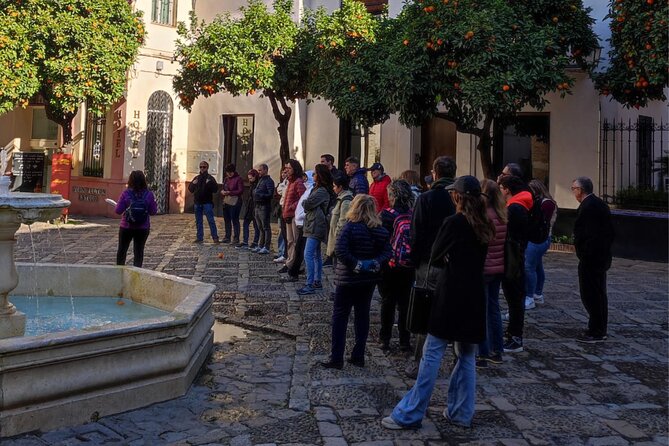
Next you head toward Puerta del Perdon. The tour frames walking through Seville as a memory-maker, and this is where the route leans into photo and legend. You’re told about the collapse of the Giralda and where to aim your camera for one of the best views of Seville. Even if you’ve seen Giralda postcards, this stop helps you see what the guide means by perspective.
Then you reach Plaza de la Virgen de los Reyes, the cathedral-adjacent zone tied to the Giralda. The guide’s angle here is simple but effective: you cannot miss this cathedral area, yet you may still not know how key parts were made or finished through history. The promise is that you’ll see what you don’t see, meaning the details are not obvious unless someone points them out.
After the cathedral zone, the tour continues to the Palacio Arzobispal. This is marked as admission not included, so think of it as an architectural and narrative stop rather than a “go inside and tour” moment. The story described here is dramatic in tone, tied to the archbishopric and the idea of horror vacui, the fear of empty space. It’s the kind of anecdote that makes a facade feel like a living argument about power.
If you only have a short time in Seville, this section does a lot of the heavy lifting. It gives you a big visual anchor (Giralda and the cathedral zone) plus a storytelling lens that helps you interpret what you’re seeing.
Still around Seville, a different sort of day:
- Seville: Setas de Sevilla Entry Ticket
★ 4.6 · 8,901 reviews - Seville: Cathedral, Giralda & Alcazar Entry With Guided Tour
★ 4.6 · 8,560 reviews - Seville: Priority Access Cathedral, Giralda & Alcázar Tour
★ 4.8 · 7,563 reviews - Seville: Guadalquivir River Cruise
★ 3.9 · 6,921 reviews
Santa Cruz and the Jewish Quarter, from Plaza de Santa Marta to Calle Vida
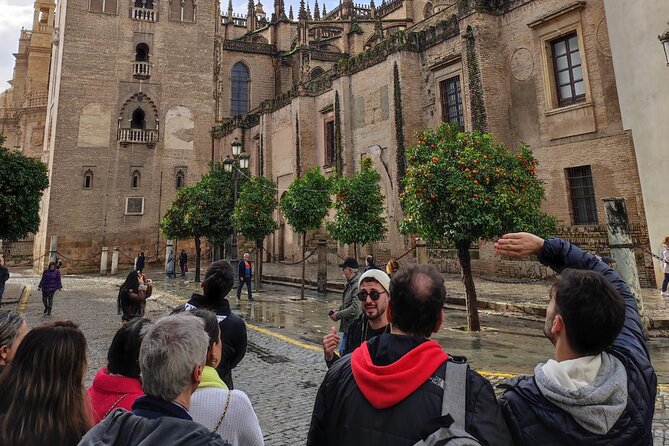
This is the heart of the “three cultures” theme, because you shift into the lanes where the Jewish Quarter imprint feels both historical and intimate. You enter a string of stops that each act like a mini map inside the neighborhood.
Plaza de Santa Marta is the first of these, and it’s described as a hidden square where you’ll hear a reaction like ohhh when you arrive. The explanation centers on one of the largest Jewish communities the city had, and that’s the right way to approach it. Look around the square and try to imagine daily life rather than only major monuments.
Then you reach Plaza de la Alianza, a square identified as part of the old Jewish Quarter. The tour emphasizes that the space is the sum of many villages that passed through here, using that as a way to explain Seville as a city of movement and mixing, not a single static identity.
Plaza de Dona Elvira follows, and it’s timed like a photo opportunity for the Santa Cruz neighborhood. You’re also guided toward the lived presence of historic minorities and their curious superstitions. This is where the tour gets more human. Instead of only empires and churches, you hear about beliefs, fears, and the strange logic people used to make sense of uncertainty.
Calle Susona is next, and the tour clearly treats it like a neighborhood legend. It’s presented as something you experience with all your senses tuned, not just an address on a sign. Then Calle Vida is paired with the idea of Muerte street nearby, and the guide sets you up to choose which one you cross. That playful framing matters because it stops the tour from turning too solemn. You can take it seriously while still letting the streets be interesting.
Finally in this sequence, you reach the Juderia area. After the route so far, it’s meant to feel like colors, flavors, and smells of Seville are back in the foreground. Even if you’re not there to eat, this is a good mental reset toward how neighborhoods function: shops, homes, daily routines, and the social web that follows people through time.
Royal Alcazars connections and photo towers: Patio de Banderas to Torre Abdel Aziz
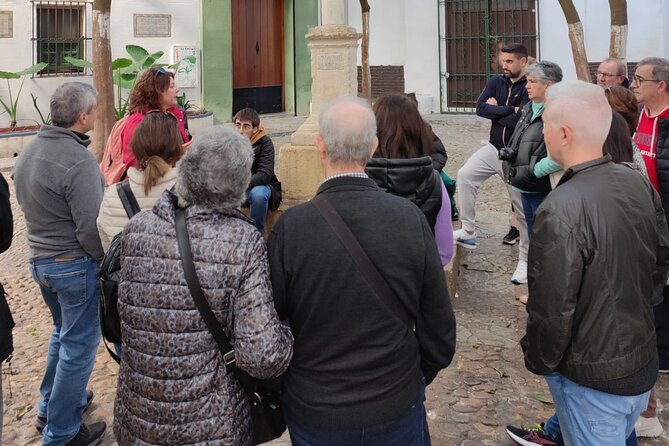
After the Jewish Quarter focus, you transition back into the power structures and iconic edges of old Seville. Plaza del Patio de Banderas is placed as a key hinge point linked to the Royal Alcazars of Seville. The guide frames the area as centuries of history on your feet, with questions about who succeeded each other and what they left behind. You’re not trying to “win” a trivia contest, you’re trying to read the city like a palimpsest.
Puerta del Leon comes next. It is marked as admission not included, but the stop still has value because it’s about symbology, defense, heraldry, customs, and kings who passed through its walls. Even from the outside, a gate like this is basically a story about borders and identity, and that theme returns later as the route heads toward the river.
You then reach the Archivo General de Indias, also admission not included. The tour makes an unexpected joke or at least a surprising framing: even today it’s described as having the most pirates, explained by what is kept so carefully. The point is to connect a place of records to the human drama of navigation and empire paperwork, where ships and secrets move together.
Monumento a la Inmaculada Concepcion is a quick shift into how Seville also expresses religious and artistic energy. The tour note here includes the idea that Seville has been a city of great painters and artists, plus a claim about the first marketing campaign in history. Even if you don’t know the exact details yet, the stop gives you a reason to notice how Seville uses public monuments as communication.
Then you get back to the icon zone: Giraldillo is a highlight that the tour treats like a must-see symbol you can almost touch. But the guide also warns that the view can deceive, which is a great reminder to look at more than one angle as you take photos.
Finally you reach Torre Abdel Aziz. This is framed as the moment when the guide teaches you where to stand, from photo spots to the feeling of tower greatness, walls, palaces, and beautiful houses. If you’re the type who wants one or two “I nailed it” photos, this section is built for you.
Arenal, Triana, and the Torre del Oro finish line
The last stretch shifts away from the densest historic core and toward an area that feels more open, connected to trade and river movement. Arco del Postigo del Aceite is a story-shaped stop, described as a place that seems straight out of stories, with good times and bad times tied to events around it. Then Plaza Del Cabildo arrives as a visual payoff, a square the tour says you can multiply in beauty if you pause and look.
Mercado Artesania El Postigo follows, and this is a practical, modern-feeling stop at the end of a historical storyline. The guide frames it as “we are a bit of each of the villages” that settled here, keeping the best of each in what you can see and experience. It’s not just shopping talk. It’s a way to end the tour thinking about how culture keeps remixing itself.
Puente de Isabel II, also called Puente de Triana, is where the route crosses into the Triana-side perspective. You get time for photos and playful comparisons, plus pilgrim stories of those who crossed it. Finally, the walk ends at Torre Del Oro on the river.
Torre del Oro is marked as admission not included, but the tour promises something more important than ticketed rooms: understanding that feels almost absolute by the time you arrive. It also says it saves the end for when you see you, which is a hint that the best payoff is visual and emotional rather than indoor.
Who should book this, and who might want a different style
This tour is best for you if you want a tight, guided walk that connects neighborhoods to eras and legends without reading a single long wall of text. It’s also ideal if you like photo stops planned around viewpoints, since the route specifically targets the Giralda area and the river ending.
You’ll also get a lot out of it if you enjoy social history, like how different communities left marks and how people carried beliefs and superstitions through daily life. And since the group size is limited, you can ask quick questions without the guide losing the thread.
You might choose a different option if you need long time inside monuments. Several of the stops are explicitly marked admission not included, so the tour is about seeing and understanding the city’s structure, not doing full interior museum time at every point.
Should you book Seville of the 3 Cultures?
I think you should book it if you want maximum payoff from a first half-day in Seville. For $13.88 and about 2 hours, you get a guided route that ties together Roman, Al-Andalus, Christian, and Jewish influences in a way that makes the streets feel like a map, not a blur.
It’s also a smart pick when you want a human guide tone, the kind you can hear in storytelling examples from guides like Alfredo and Jose. Just go in expecting a fast-moving walk with narrative highlights, and plan extra time on your own later if you want to enter the admission-charge sites.
FAQ
How long is Seville of the 3 Cultures?
The tour lasts about 2 hours.
Where does the tour start and end?
It starts at Pl. de S. Francisco, 17, Casco Antiguo, 41004 Sevilla, Spain, and ends in the Torre del Oro area at P.º de Cristóbal Colón, s/n, Casco Antiguo, 41001 Sevilla, Spain.
Is there a mobile ticket?
Yes. The experience includes a mobile ticket.
How big is the group?
The tour has a maximum of 20 travelers.
Are any attractions included in the price?
Some stops are marked free, while several sights are marked as admission not included, including Palacio Arzobispal, Puerta del Leon, Archivo General de Indias, and Torre del Oro.
When do I get confirmation?
Confirmation is received at the time of booking.
Is service allowed on this tour?
Yes, service animals are allowed.
Is public transportation nearby?
The tour is listed as being near public transportation.
Can most people participate?
The tour notes that most travelers can participate.
What is the cancellation policy?
Free cancellation is allowed up to 24 hours in advance for a full refund. If you cancel less than 24 hours before the start time, the amount paid is not refunded.
Recently reviewed around Seville
- The Villages of Andalusia: Full-Day Trip from Seville★ 4.8 · 19 reviews
- From Seville: White Villages Tour★ 5.0 · 9 reviews
- White Villages and Ronda: Day Trip from Seville★ 4.9 · 89 reviews
- White Villages & Ronda 2-Days Trip & Overnight Stay★ 4.6 · 5 reviews
- Seville: Guided visit of the Casa de Pilatos with entrance tickets★ 4.3 · 18 reviews
- Triana Market Tapas Tour★ 4.9 · 12 reviews
- Your Photo Story in Seville★ 5.0 · 16 reviews
- Transfer Hotel Seville-Seville Airport★ 4.5 · 15 reviews